
You'll need this:
-
One of these Pointerpro plans:
 Professional Enterprise
  ReportR DistributR
Check this video for a step-by-step Spider Chart configuration:
On this help guide page:
1. Add a spider chart to the page
To add a spider chart widget to the page, all you have to do is click on it and drag and drop it on the page.
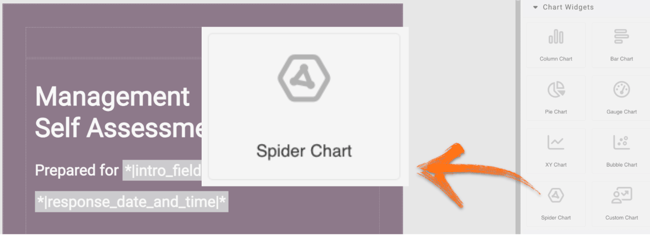
Once you add the widget, a pop-up window will open where you can setup the chart.
2. Setup the widget
The key building blocks of this graph are the axes and the points of data displayed on the graph. Let's see now how to set up these components!
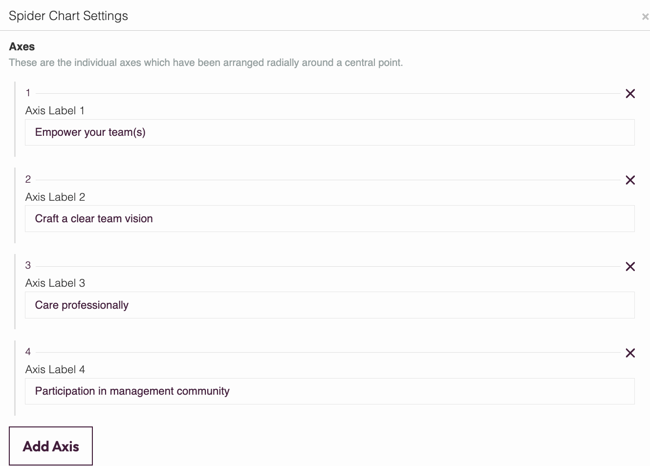
Start by clicking Add axis to start creating the axes for your data points. Give each axis a label and continue to add axes until you have the number of axes that you need. You can include as many axes as you want, but the most visually appealing and clear would be between three and six axes.
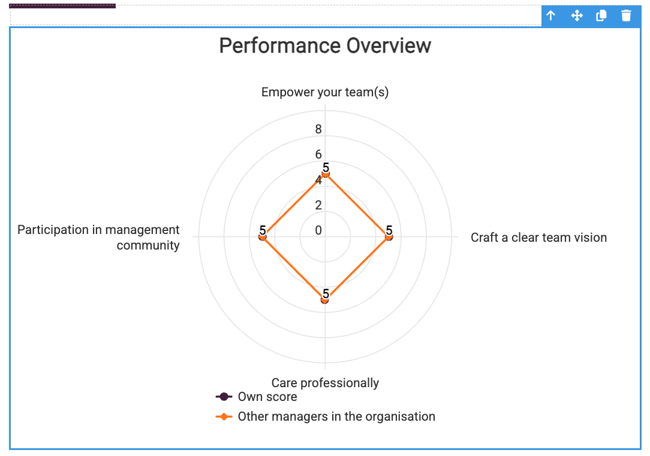
The example below uses four axes.
Now it's time to start specifying how the first data series should be constructed. This is the line of points that will be plotted on the axis and connected to form a polygon with a coloured line of your choice.
Note that the number of data points must correspond to the number of axes so that you'll have a data point plotted on each axis. For example, in a spider chart of four categories, there are four axes, so for each data series, there are four data points.
Data points can be variables or static numbers that you choose and can be a mixture of both - some lines can be variables and some numbers.

- Series Label - give a name to the line. This is the name of the line that will be shown in the legend under the graph.
- Series Colour - choose the line colour by clicking on the colour selector. Take care to choose distinctly different colours for each of the lines so it will be easy to tell the difference between them!
- Serie Visualisation - choose line, coluored layer, or column to change the display.
- Data Point Metrics - choose where the data for the graph should be taken from. You can either type in a number or click Variables to access the drop-down menu of variables that you can use. Variables take the data entered during the survey and display it in the graph. Data Point 1 Metric will correspond with Axis Label 1.
- Add point - click add point until you have added all the points you need to be plotted on your axes.
Always make sure your data point metrics are smaller than the maximum value on axis to make sure no points are put outside of the graph.
Click Add series to continue adding as many lines as you would like to be shown on the graph. In the example above, we created two lines - 'Own score' and 'Other managers in the organisation'.
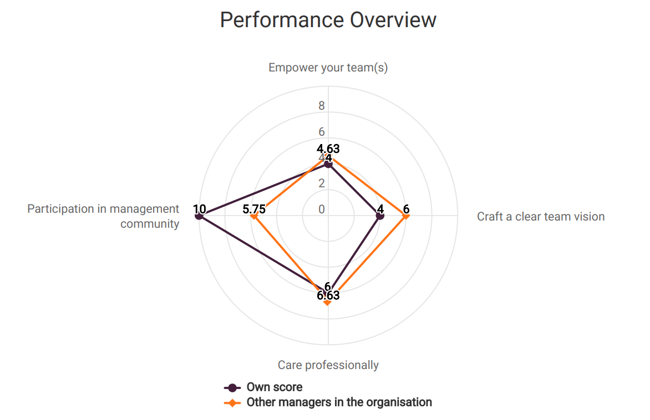
Now you've set up your graph, you can also configure the last settings.

- Chart title - name your graph, the name will be displayed at the report
- Intervals - add your own intervals, which are the numbers marking the scale shown on the inside of the graph. Use the arrows to change the axis interval label and choose the number that you want to be shown at each of the intervals. Use the arrows or type in the value that you wish to set for the maximum value on-axis.
- Show data point numbers - deactivate this option to hide the data point numbers from the chart
- Display type - choose whether you want your graph to be displayed as a circle or polygon.
3. Additional settings
Select the widget and then at the right of the screen click on the Settings button. The widget list will be replaced by the additional settings.
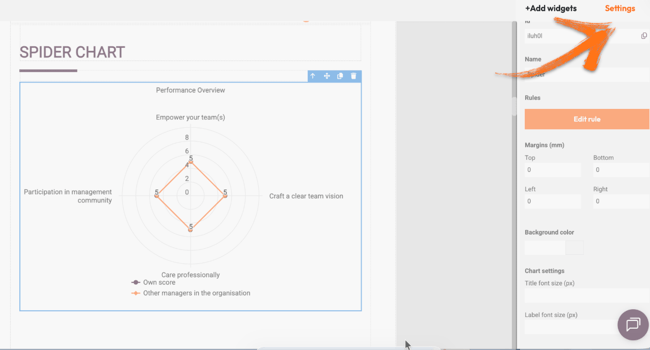
Here you can find the following settings:
1. ID
This is the ID of the widget.
2. Name
You can name your widget in order to identify it easier.
3. Rules
You can add your widget logic rules to ensure that your content will be visible only when the conditions are true.
4. Margins
Add margins to create space around elements and move them in your page. By default the margins are set to 0, but you can change that anytime and add the margin you prefer.
You can add margins left and right to make your chart smaller. The bigger the margins, the smaller the chart. Note that the margins should be equal, in order for the chart to be centred in the page.
5. Background colour
You can change the background colour of this specific widget by clicking the colour selector.
6. Chart settings
You can change the default title and label font size if you want. This is very useful if you are placing your chart inside a column, or you adjust its size. In this case you will have a smaller chart but your text will still be readable.
4. Additional buttons
When you click on your widget, 4 blue buttons appear in the upper right corner.
The Arrow allows you to move between the different layers of the page. For example if you add a widget in a column then you have 3 layers: the page, the column and the widget. The arrow allows you to quickly select a different layer.
The second icon, the four arrow sign, allows you to move your widget up or down to the page.
The third icon, the page, allows you to copy this widget and the forth icon, the bin, to delete it.
What's next?
- Chart Widgets: Bubble chart: The bubble chart widget allows your respondents to see their results from different questions but also compare them to other components. A bubble chart stands out because it allows a comparison between three variables.
-
Chart Widgets: Bar chart: Add a Bar Chart widget to your customised report to show respondents' results or another data set at a glance. This way you will display your data with rectangular bars. It allows you to show data separated into categories with relative numbers.
- Chart Widgets: Gauge chart: Add a gauge chart to your personalised PDF report to represent average or actual scores or percentage results for question blocks or formulas. Respondents can see at a glance if they've scored towards the top-end or bottom-end of the scale. It allows you to display a large data set visually.
Don't want to build it yourself? Contact our professional services team